

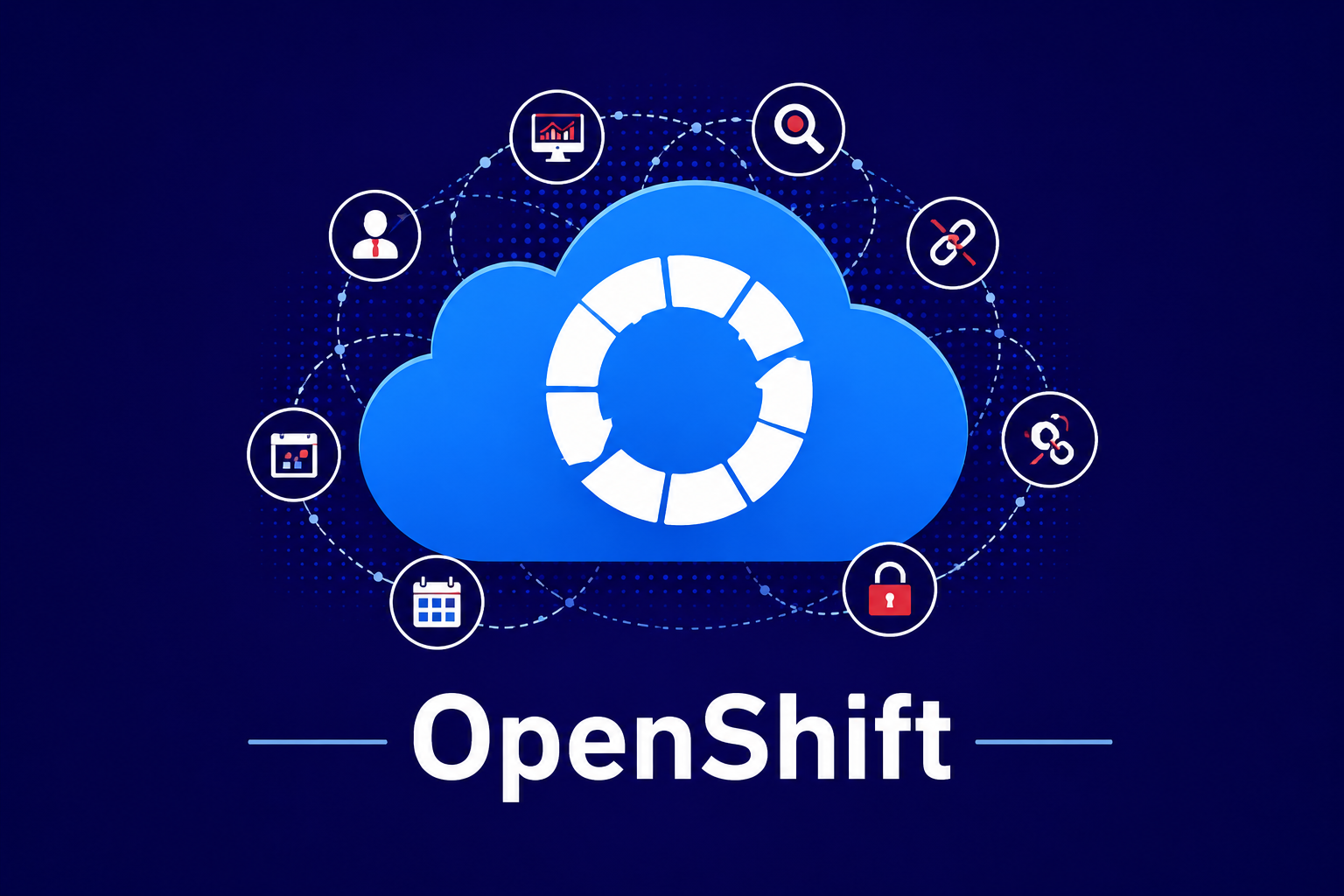
☸️ Red Hat OpenShift Training Guide
OpenShift is the industry-leading enterprise Kubernetes platform. It provides a consistent foundation for delivering applications across the hybrid cloud, from edge computing to public cloud environments. This training guide focuses on mastering the tools needed to automate, manage, and scale containerized applications.
⚡ Program Highlights
-
30 Hours of Live Expert Training: Practical sessions covering Docker, Kubernetes, and OpenShift.
-
12 Hands-on Assignments: Real-world scenarios for cluster management and application deployment.
-
2 Capstone Projects: End-to-end implementation of a containerized environment.
-
Lifetime Access: Permanent entry to the LMS including all session recordings and resource guides.
🧭 Course Syllabus & Learning Path
Our curriculum is built to prepare you for the Red Hat Certified OpenShift Administrator (EX280) and Application Developer (EX188) certifications.
1. Foundations of Containers
-
Docker & Podman: Creating, managing, and optimizing container images.
-
Container Orchestration: Understanding why Kubernetes is the backbone of modern DevOps.
2. OpenShift Cluster Management
-
Installation & Configuration: Setting up OpenShift clusters on-premises and in the cloud.
-
User Management: Configuring RBAC (Role-Based Access Control) and identity providers.
-
Networking: Managing Services, Routes, and Ingress controllers.
3. Application Lifecycle Management
-
Deployment Strategies: Mastering Rolling updates, Recreate, and Blue-Green deployments.
-
Storage: Managing Persistent Volumes (PV) and Persistent Volume Claims (PVC).
-
Monitoring & Logging: Utilizing Prometheus and Grafana for cluster health.
🏆 Why Pursue OpenShift Certification?
-
Enterprise Standard: Most Fortune 500 companies use OpenShift for their production Kubernetes environments.
-
Hybrid Cloud Mastery: Learn to move applications seamlessly between AWS, Azure, and private data centers.
-
Career Growth: OpenShift specialists are among the highest-paid professionals in the DevOps and Cloud Architecture space.
🛠️ Key Training Features
-
Real-life Case Studies: Analyze how organizations use OpenShift to reduce deployment times by up to 70%.
-
24/7 Technical Support: Get help with lab environments and configuration errors at any time.
-
Job Assistance: We provide resume reviews and interview preparation with a network of global hiring partners.
Curriculum
- 16 Sections
- 0 Lessons
- 30 Hours
- Module 1: Introduction to OpenShift and ContainerizationThis module introduces container technology, Docker fundamentals, Kubernetes concepts, and the Red Hat OpenShift platform. Students will understand how containerized applications are developed, deployed, and managed in modern cloud-native environments.0
- Module 2: OpenShift Architecture and Core ComponentsStudents will explore OpenShift architecture, including clusters, nodes, pods, services, routes, image registries, operators, and networking components. The module provides a strong foundation for understanding enterprise container platforms.0
- Module 3: OpenShift Installation and Environment SetupThis module covers OpenShift installation methods, cluster setup, environment configuration, project creation, and infrastructure requirements. Learners will gain hands-on experience deploying OpenShift environments.0
- Module 4: Working with Containers and ImagesStudents will learn how to create, manage, and optimize container images using Podman and OpenShift tools. Topics include image registries, image lifecycle management, container storage, and image security practices.0
- Module 5: Application Deployment on OpenShiftThis module focuses on deploying applications using container images, templates, manifests, deployment configurations, and OpenShift projects. Students will learn how to manage application lifecycles within OpenShift clusters.0
- Module 6: Kubernetes Fundamentals in OpenShiftStudents will explore Kubernetes concepts including Pods, ReplicaSets, Deployments, Services, ConfigMaps, Secrets, and Namespaces. The module demonstrates how OpenShift extends Kubernetes capabilities for enterprise use cases.0
- Module 7: Networking and Service ManagementThis module covers OpenShift networking, services, routes, ingress controllers, load balancing, service discovery, DNS management, and external application exposure. Students will learn how applications communicate within and outside the cluster.0
- Module 8: Storage and Persistent VolumesStudents will learn storage concepts including Persistent Volumes (PV), Persistent Volume Claims (PVC), Storage Classes, dynamic provisioning, and application data management. The module focuses on managing persistent storage for enterprise workloads.0
- Module 9: Security and Access ManagementThis module introduces authentication, authorization, role-based access control (RBAC), Security Context Constraints (SCC), OAuth integration, user management, and security best practices for OpenShift environments.0
- Module 10: OpenShift Operators and AutomationStudents will explore Operators, OperatorHub, custom resources, automated application lifecycle management, cluster services, and infrastructure automation. The module focuses on simplifying operations through Kubernetes-native automation.0
- Module 11: Monitoring, Logging, and TroubleshootingThis module covers cluster monitoring, log management, application diagnostics, performance analysis, alerting systems, and troubleshooting techniques. Students will learn how to maintain healthy and reliable OpenShift environments.0
- Module 12: CI/CD and DevOps IntegrationStudents will learn Continuous Integration and Continuous Deployment (CI/CD) practices using OpenShift Pipelines, GitOps, Jenkins integration, automated deployments, and DevOps workflows. The module focuses on modern software delivery practices.0
- Module 13: OpenShift Administration and Cluster ManagementThis module teaches cluster administration, node management, scaling, upgrades, resource allocation, capacity planning, high availability, and production cluster maintenance. Students will gain practical administration skills for enterprise environments.0
- Module 14: Cloud-Native Applications and MicroservicesStudents will learn microservices architecture, container orchestration, service communication, scalability, resilience patterns, and cloud-native application design principles using OpenShift.0
- Module 15: Real-World Projects and Enterprise Use CasesStudents will work on practical projects involving application deployment, CI/CD implementation, cluster administration, container security, monitoring solutions, and enterprise cloud-native architectures. These projects provide hands-on industry experience.0
- Module 16: Certification and Career PreparationThe final module focuses on Red Hat OpenShift certification preparation, interview questions, troubleshooting scenarios, resume building, portfolio development, and industry best practices. Students will be prepared for roles such as OpenShift Administrator, DevOps Engineer, Platform Engineer, Kubernetes Administrator, Cloud Engineer, and Site Reliability Engineer (SRE).0

Courses you might be interested in
-
0 Lessons
-
0 Lessons
-
0 Lessons
-
0 Lessons