
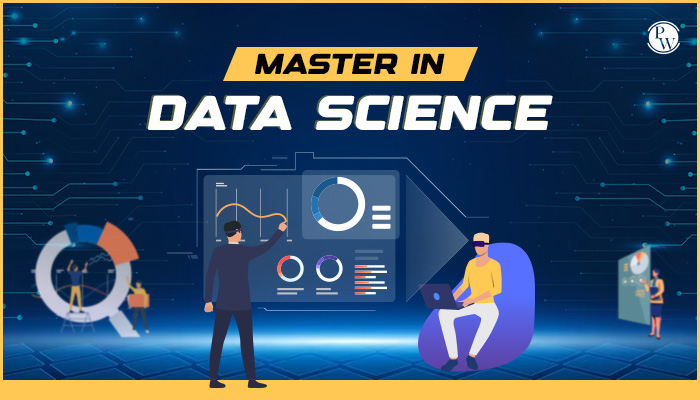
🎓 Data Scientist Masters Program
The Data Scientist Masters Program is an elite, industry-aligned learning path designed to transform you into a professional Data Scientist. Unlike standalone courses, this program integrates multiple specializations—from data visualization to deep learning—to provide a 360-degree understanding of the data ecosystem.
⚡ Program at a Glance
-
6 Comprehensive Courses: A curated sequence including Tableau, Python, AI, and Machine Learning.
-
245 Hours of Content: High-quality video training designed for deep mastery.
-
12 Real-world Projects: Build a robust portfolio that demonstrates your ability to solve complex business problems.
-
129 Hands-on Assignments: Rigorous practical tasks to ensure skill retention.
🧭 The Master’s Learning Path
This program is structured into specialized modules to build your expertise progressively.
1. Data Visualization (Tableau)
-
Visual Analytics: Moving from raw data to insightful dashboards.
-
Data Blending: Combining disparate data sources for comprehensive analysis.
2. Core Data Science & Python
-
Python Essentials: Mastering the industry-standard language for data manipulation.
-
Statistics & Math: The foundational logic behind every predictive model.
3. Machine Learning & AI
-
Predictive Modeling: Implementing supervised and unsupervised learning algorithms.
-
Advanced AI: Building intelligent systems that learn and adapt from data.
4. Deep Learning & TensorFlow
-
Neural Networks: Understanding the architecture of Deep Learning.
-
TensorFlow: Using the world’s most popular library for building high-performance ML models.
🏆 Exclusive Master’s Features
-
Personal Learning Manager: A dedicated human guide to assist with your learning journey and answer queries.
-
Batch Flexibility: Life happens—switch between weekday or weekend batches as your schedule changes.
-
Job Assistance: Direct resume sharing with 200+ global hiring partners across the USA and India.
-
Lifetime Access: Permanent entry to all presentations, quizzes, and installation guides.
Curriculum
- 8 Sections
- 0 Lessons
- 245 Hours
- Module 1: Data Science Foundations and ProgrammingThis module introduces Data Science concepts, analytics lifecycle, Python programming, data structures, algorithms, statistics, probability, linear algebra, and database fundamentals. Students will build a strong foundation in the mathematical and programming skills required for data science.0
- Module 2: Data Collection, Preparation, and VisualizationStudents will learn data acquisition, data cleaning, data transformation, exploratory data analysis (EDA), feature engineering, SQL, data wrangling, and visualization techniques using tools such as Matplotlib, Seaborn, Tableau, and Power BI. The module focuses on preparing high-quality datasets and communicating insights effectively.0
- Module 3: Machine Learning and Predictive AnalyticsThis module covers supervised and unsupervised learning, regression, classification, clustering, model evaluation, feature selection, ensemble techniques, and predictive modeling. Students will learn how to build intelligent systems that extract patterns and generate business insights from data.0
- Module 4: Deep Learning and Artificial IntelligenceStudents will explore neural networks, deep learning architectures, Convolutional Neural Networks (CNN), Recurrent Neural Networks (RNN), TensorFlow, Keras, computer vision, and AI applications. The module focuses on solving complex real-world problems using advanced AI techniques.0
- Module 5: Big Data Engineering and Cloud TechnologiesThis module introduces Hadoop, Apache Spark, Data Lakes, cloud computing platforms, distributed systems, cloud-native analytics, and scalable data processing frameworks. Students will learn how modern enterprises manage and analyze large-scale datasets.0
- Module 6: Natural Language Processing and Generative AIStudents will learn text analytics, NLP, sentiment analysis, language models, transformers, prompt engineering, Retrieval-Augmented Generation (RAG), Large Language Models (LLMs), and Generative AI applications. The module focuses on building intelligent systems capable of understanding and generating human language.0
- Module 7: MLOps, Model Deployment, and Data Science OperationsThis module covers MLOps practices, model deployment, API development, cloud deployment, monitoring, automation, version control, CI/CD for machine learning, and production-grade AI systems. Students will learn how to operationalize machine learning models in enterprise environments.0
- Module 8: Real-Time Projects, Certification, and Career PreparationStudents will work on end-to-end projects involving predictive analytics, recommendation systems, business intelligence, NLP solutions, computer vision, and Generative AI applications. The module also includes interview preparation, portfolio development, resume building, capstone projects, and career guidance for roles such as Data Scientist, Machine Learning Engineer, AI Engineer, Analytics Consultant, and Data Science Architect.0
Courses you might be interested in
-
0 Lessons
-
0 Lessons
-
0 Lessons
-
0 Lessons