

Ab Initio Online Training & Certification Guide
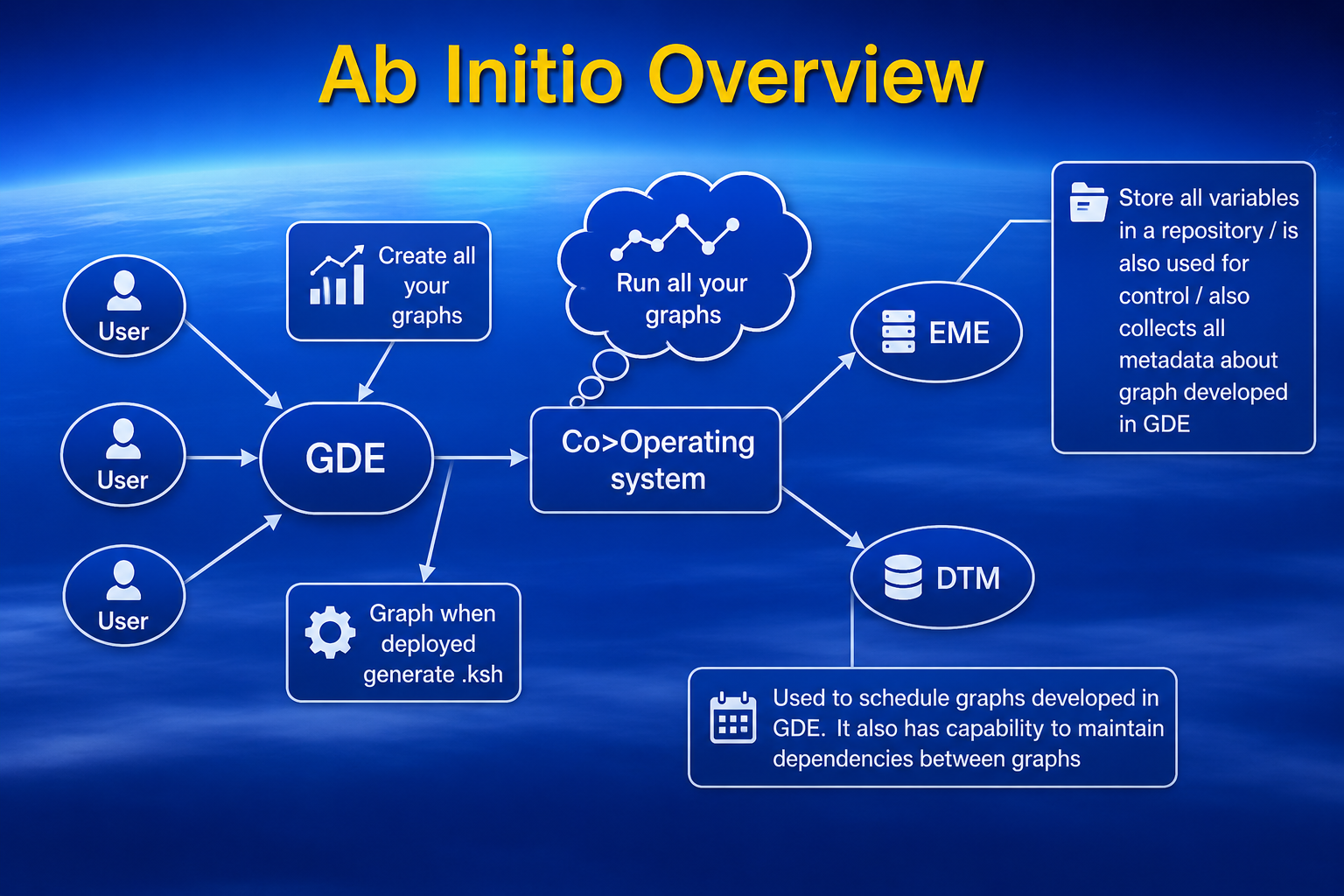
Ab Initio is a premier enterprise-class Business Intelligence and ETL platform. Known for its powerful parallel processing capabilities and graphical user interface, it is the industry standard for high-volume data processing and complex data integration. ITGuru’s expert-led training provides a deep dive into the Ab Initio ecosystem, preparing you for high-level data engineering roles.
4.9 ★★★★★ (1.6K+ Reviews) | 3.8K+ Learners
### Course Strategic Overview
In the era of Big Data, the ability to process massive datasets with speed and accuracy is critical. ITGuru’s Ab Initio Training provides comprehensive, real-time knowledge of the platform’s core products. This course is designed to take you from a foundational understanding to professional mastery of data analysis, metadata management, and actionable business intelligence.
### Key Training Features
-
30 Hours of High-Quality Training: Extensive deep-dive sessions covering basic to expert-level concepts.
-
Lifetime Access: Permanent entry to our Learning Management System (LMS) with all recordings, installation guides, and resources.
-
18 Hands-on Assignments: Practical exercises designed to master every component of the Ab Initio toolset.
-
2 Real-time Projects: Industry-standard projects to build a professional portfolio.
-
24/7 Expert Support: On-demand technical assistance to resolve queries instantly.
-
Job Assistance: 100% placement support through our global network of 200+ partner companies.
### Ab Initio Certification Syllabus
| Module | Core Learning Areas |
| Module 1: Introduction | Understanding Ab Initio Architecture, GDE (Graphical Development Environment), and Co-Operating System. |
| Module 2: Core Components | Mastering Dataset Components, Partitioning/De-partitioning, and Transform Components (Reformat, Rollup, Join). |
| Module 3: Advanced Features | Working with Multi-file Systems (MFS), Lookups, and Database Components. |
| Module 4: Design & Optimization | Graph Design best practices, Performance Tuning, and Parallelism strategies. |
| Module 5: Metadata & Ops | Metadata Hub, EME (Enterprise Meta-Environment) fundamentals, and Error Handling. |
### Why Enroll in this Certification?
-
Parallel Processing Power: Master the tool used by the world’s largest banks and telecommunications firms.
-
Career Growth: High demand for Ab Initio Developers in data-intensive industries ensures premium salary packages.
-
Certified Expertise: Our curriculum is mapped to meet the latest industry standards and certification requirements.
### Training Options
-
Live Online Training (Preferred): Interactive, expert-led batches with real-time Q&A and laboratory sessions.
-
Self-Paced Learning: Flexible, high-quality video content for independent study at your own speed.
-
Corporate Training: Bespoke modules customized to align with your organization’s specific data architecture.
### Frequently Asked Questions (FAQ)
Q: What are the prerequisites for Ab Initio training?
A: A basic understanding of SQL and Unix/Linux commands is beneficial but not mandatory, as we cover the essentials in the course.
Q: Will I get a certificate upon completion?
A: Yes. You will receive an industry-recognized Ab Initio Course Completion Certificate once you finish the assignments and projects.
Q: Do you offer placement support?
A: Absolutely. Our dedicated support team shares your resume with top-tier clientele and provides interview preparation to ensure 100% placement success.
Q: Can I attend a demo session?
A: Yes, you can register for a Free Demo to experience the training quality before enrolling.
Curriculum
- 16 Sections
- 0 Lessons
- 30 Hours
- Module 1: Introduction to Ab Initio and Data WarehousingThis module introduces Ab Initio, ETL concepts, data warehousing fundamentals, and enterprise data integration. Students will understand how Ab Initio is used to process, transform, and manage large-scale business data in enterprise environments.0
- Module 2: Ab Initio Architecture and ComponentsStudents will learn the core components of Ab Initio, including GDE (Graphical Development Environment), Co>Operating System, Enterprise Meta>Environment (EME), Conduct>IT, and Continuous Flows. The module provides a strong foundation in the Ab Initio ecosystem.0
- Module 3: Installation and Environment SetupThis module covers Ab Initio installation, project setup, environment configuration, repository management, server connectivity, and development environment preparation. Learners will gain hands-on experience working with Ab Initio tools.0
- Module 4: Graphical Development Environment (GDE)Students will learn how to create graphs, use components, define flows, configure metadata, and build ETL processes using the Graphical Development Environment. The module focuses on visual ETL development techniques.0
- Module 5: Data Extraction and File ProcessingThis module teaches how to read and process data from flat files, databases, XML files, and enterprise applications. Students will learn file handling, metadata management, and source system integration techniques.0
- Module 6: Core Ab Initio ComponentsStudents will work with essential Ab Initio components such as Reformat, Filter By Expression, Join, Sort, Rollup, Scan, Normalize, Denormalize, Partition By Key, and Merge. The module focuses on implementing business transformation logic.0
- Module 7: Data Transformation and ETL DevelopmentThis module covers data transformation techniques, business rule implementation, data cleansing, aggregation, validation, enrichment, and data movement processes. Students will learn how to build scalable ETL workflows.0
- Module 8: Parallel Processing and Performance OptimizationStudents will explore Ab Initio's parallel processing architecture, partitioning methods, data parallelism, pipeline parallelism, and optimization techniques. The module focuses on high-performance data processing for large datasets.0
- Module 9: Advanced Components and Complex TransformationsThis module introduces advanced Ab Initio components, custom functions, multifile systems, lookup operations, complex joins, partitioning strategies, and reusable ETL frameworks for enterprise-scale projects.0
- Module 10: Meta Programming and Metadata ManagementStudents will learn metadata-driven development, parameterization, reusable components, metadata management, and Enterprise Meta>Environment (EME) features. The module helps automate and standardize ETL development processes.0
- Module 11: Job Scheduling and Workflow AutomationThis module focuses on Conduct>IT, workflow orchestration, dependency management, scheduling, monitoring, automation, and batch processing techniques. Students will learn how to manage enterprise ETL operations efficiently.0
- Module 12: Error Handling and TroubleshootingStudents will explore debugging methods, log analysis, error handling strategies, recovery mechanisms, exception processing, and troubleshooting techniques. The module prepares learners to support production ETL environments.0
- Module 13: Ab Initio Administration and SecurityThis module covers user management, access control, environment administration, security implementation, repository maintenance, system monitoring, and governance best practices for enterprise deployments.0
- Module 14: Real-Time Processing and Big Data IntegrationStudents will learn real-time data integration, streaming concepts, API connectivity, cloud integration, Hadoop ecosystem integration, and modern data engineering approaches using Ab Initio technologies.0
- Module 15: Industry Projects and Case StudiesStudents will work on real-world projects involving data migration, customer analytics, banking ETL solutions, financial reporting, healthcare data processing, and enterprise data warehouse implementations.0
- Module 16: Certification and Career PreparationThe final module focuses on Ab Initio interview preparation, project discussions, resume building, portfolio development, troubleshooting scenarios, and industry best practices. Students will be prepared for roles such as Ab Initio Developer, ETL Developer, Data Engineer, Data Integration Specialist, and Data Warehouse Consultant.0

Courses you might be interested in

-
0 Lessons
-
0 Lessons
-
0 Lessons

-
0 Lessons