
🤖 Artificial Intelligence Masters Program
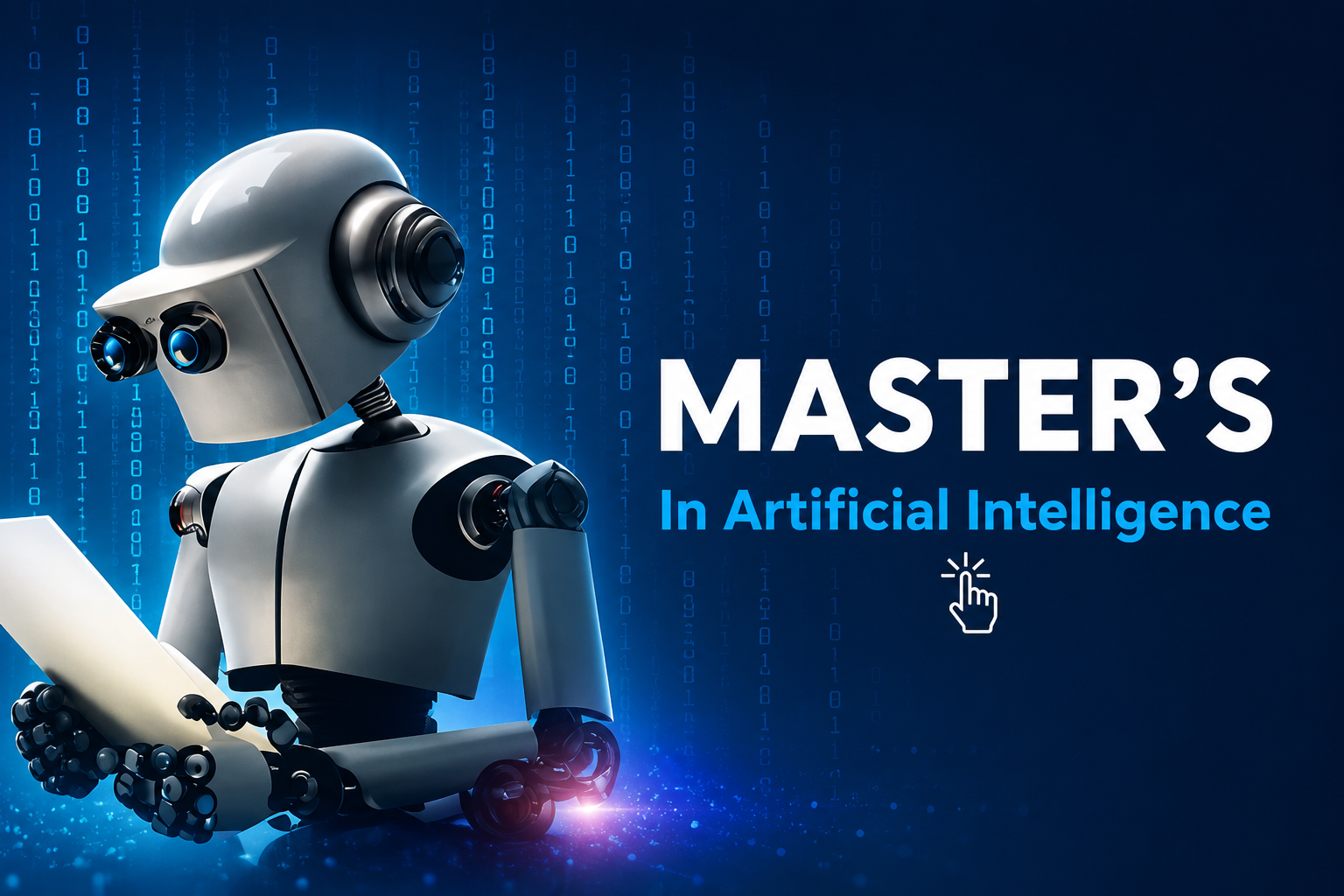
The Artificial Intelligence Master’s Program is an elite, industry-aligned learning path designed to transform you into a specialist in AI, Machine Learning, and Deep Learning. This program isn’t just a single course; it is an organized curriculum of 8 comprehensive courses that provide the deep technical expertise required to lead automation and intelligence projects in the IT industry.
⚡ Program at a Glance
-
285 Hours of High-Quality Training: An extensive deep dive into the most relevant AI technologies.
-
16 Real-world Projects: Gain practical experience by solving complex problems with AI models.
-
152 Hands-on Assignments: Continuous evaluation to ensure you master every module.
-
Lifetime Access: Get permanent entry to the LMS, including all future updates and resources.
🧭 The Learning Path: 8 Integrated Courses
This Master’s program covers every layer of the AI stack, from data manipulation to neural networks.
1. Python Programming (The Foundation)
-
Fundamentals: Variables, Operators, and Data Structures (Lists, Tuples, Dictionaries).
-
Advanced: Multi-threading, Network Programming, and PDBC (Database Communication).
-
Data Analytics: Mastering modules like NumPy and Pandas.
2. Data Science & AI Essentials
-
Statistics & Mathematics: The core logic behind predictive modeling.
-
Machine Learning: Basics of predictive modeling and implementation in Python.
3. Machine Learning & Deep Learning
-
ML Algorithms: Supervised and Unsupervised learning applications.
-
Neural Networks: Introduction to ANN (Artificial Neural Networks) and Deep Learning fundamentals.
4. Advanced Toolsets
-
TensorFlow Course: Mastering the world’s most popular open-source library for ML.
-
Tableau Training: Visualizing raw data into actionable business intelligence.
-
Advanced Excel: Data security, Macros, and specialized functions for data analysts.
-
SAS Training: Clinical and statistical concepts for advanced data processing.
🏆 Career & Program Benefits
-
Human Learning Manager: You get a dedicated Personal Learning Manager to guide your progress and answer queries.
-
Placement Assistance: We leverage our network of 200+ global companies to help you achieve 100% placement success.
-
Alumni Network: Join a community of professionals working at top-tier global tech firms.
-
Flexible Batching: Switch between weekday or weekend batches to fit your busy schedule.
🛠️ Certification
Upon successful completion of the requirements, you will receive an Artificial Intelligence Master’s Certificate, validating your expertise across multiple domains of intelligence and automation.
Curriculum
- 14 Sections
- 0 Lessons
- 285 Hours
- Module 1: Foundations of Artificial IntelligenceThis module introduces the core concepts of Artificial Intelligence, including its history, evolution, branches, and real-world applications. Students will understand how AI is transforming industries and learn the fundamentals of intelligent systems, problem-solving, and decision-making processes.0
- Module 2: Python Programming for AIStudents will develop strong Python programming skills required for AI development. Topics include variables, data structures, functions, object-oriented programming, and working with essential libraries such as NumPy, Pandas, and Matplotlib for AI and data science projects.0
- Module 3: Mathematics and Statistics for AIThis module covers the mathematical foundations of Artificial Intelligence, including linear algebra, probability, statistics, vectors, matrices, and optimization techniques. These concepts form the basis for machine learning and deep learning algorithms.0
- Module 4: Data Science and Data PreprocessingStudents will learn how to collect, clean, transform, and analyze data for AI applications. The module focuses on exploratory data analysis, feature engineering, data visualization, and handling real-world datasets to prepare them for machine learning models.0
- Module 5: Machine Learning FundamentalsThis module introduces supervised and unsupervised learning techniques, including Linear Regression, Logistic Regression, Decision Trees, Random Forests, Support Vector Machines, and clustering algorithms. Students will build predictive models using real-world datasets.0
- Module 6: Deep Learning and Neural NetworksLearners will explore artificial neural networks, deep neural networks, activation functions, backpropagation, optimization algorithms, and model training techniques. The module provides a strong foundation in modern deep learning architectures.0
- Module 7: Computer VisionThis module focuses on image processing and computer vision technologies. Students will learn image classification, object detection, facial recognition, and Convolutional Neural Networks (CNNs), enabling them to develop AI solutions for visual data analysis.0
- Module 8: Natural Language Processing (NLP)Students will learn how machines understand and process human language. Topics include text preprocessing, sentiment analysis, language modeling, chatbots, transformers, and modern NLP applications used in intelligent conversational systems.0
- Module 9: Generative AI and Large Language ModelsThis module introduces Generative AI concepts, Large Language Models (LLMs), prompt engineering, AI content generation, embeddings, vector databases, Retrieval-Augmented Generation (RAG), and AI-powered assistants. Students will gain practical experience with modern AI tools and frameworks.0
- Module 10: Reinforcement Learning and AI AgentsStudents will explore reinforcement learning principles, reward systems, decision-making models, intelligent agents, autonomous systems, and AI automation workflows. The module demonstrates how AI systems learn through interaction with their environments.0
- Module 11: AI Deployment, MLOps, and Cloud AIThis module teaches students how to deploy AI models in production environments, monitor model performance, implement MLOps practices, and utilize cloud-based AI services for scalable enterprise applications.0
- Module 12: Responsible AI, Ethics, and GovernanceStudents will understand ethical AI practices, bias mitigation, privacy protection, AI governance frameworks, and responsible deployment strategies. The module emphasizes building trustworthy and compliant AI systems.0
- Module 13: Capstone Projects and Industry Case StudiesThis module provides hands-on experience through real-world projects such as recommendation systems, AI chatbots, predictive analytics, computer vision applications, fraud detection systems, and intelligent automation solutions. Students will build a professional portfolio showcasing their AI expertise.0
- Module 14: Certification and Career ReadinessThe final module focuses on interview preparation, resume building, GitHub portfolio development, AI certification guidance, mock interviews, and career support to help students secure roles such as AI Engineer, Machine Learning Engineer, Data Scientist, NLP Engineer, Computer Vision Engineer, and AI Solutions Architect.0
Courses you might be interested in
-
0 Lessons
-
0 Lessons
-
0 Lessons
-
0 Lessons